Build a Lean AI Marketing System for Small Business
How solopreneurs and small teams can generate leads consistently — no marketing hire, no bloated budget.
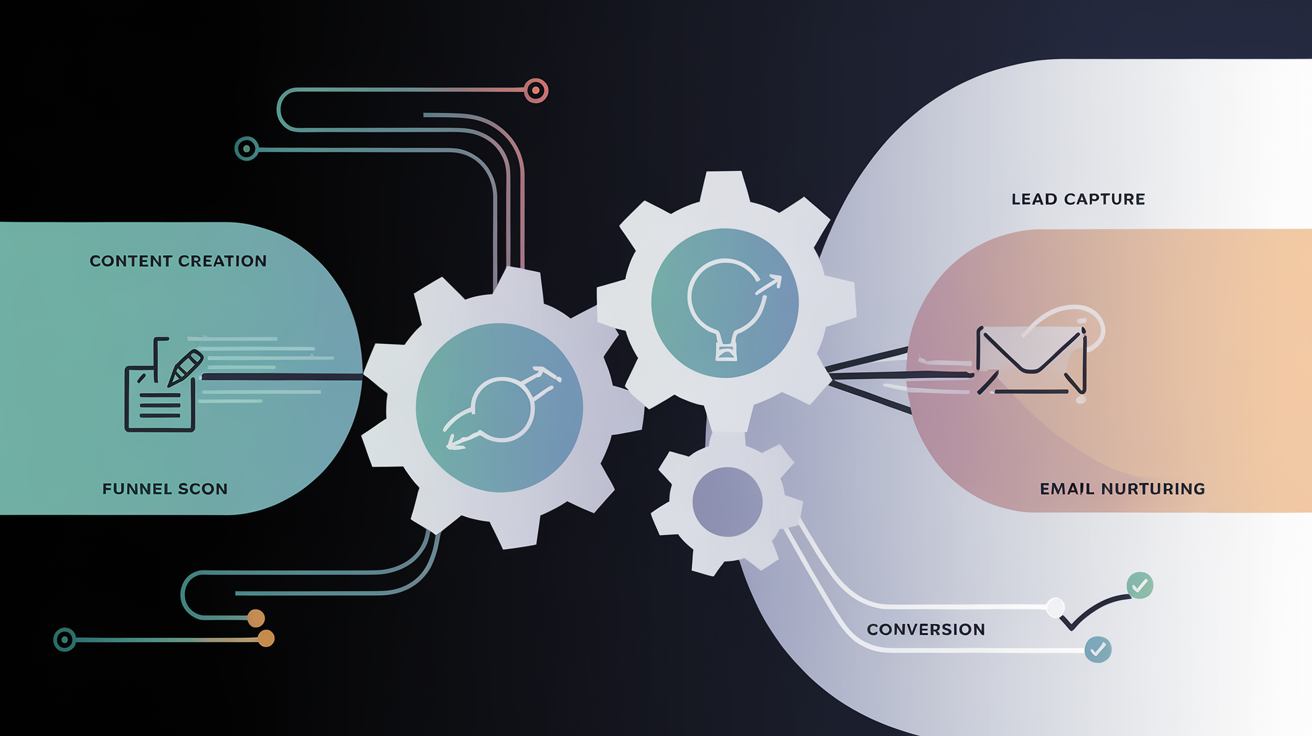
An AI marketing system for small business is a structured set of tools and automated workflows — covering content creation, lead capture, email nurturing, and conversion — that generates and qualifies leads with minimal manual effort. The goal is not to replicate what a marketing agency does. The goal is to build something smaller, faster, and cheaper that keeps running while you run the business.
Here is how to build one.
The Problem: Marketing Falls Through the Cracks
50% of SMBs have no employees dedicated to marketing, and 52% operate on monthly marketing budgets under $1,000. That means the owner is the marketer, the closer, the ops lead, and the service delivery team — often simultaneously.
The result is predictable: marketing happens when there's time, and there's never enough time. Lead flow becomes inconsistent, which creates revenue anxiety, which pulls focus away from marketing, which makes lead flow worse.
The majority of SMBs spend between 1–10 hours per week on marketing. For a business without dedicated staff, that time is constantly competing with billable work, client management, and everything else. The problem is not effort. It is that effort-based marketing does not scale.
Inconsistent lead flow is almost always a systems problem, not a budget problem. The answer is not to spend more hours on marketing tasks. It is to build a system that produces output without constant attention.
This is a practical blueprint for that system.
What a Lean AI Marketing System Actually Looks Like
A lean AI marketing system has three characteristics: minimal human touchpoints per week, consistent output regardless of how busy you are, and low ongoing cost.
The structure follows four layers:
Attract → Capture → Nurture → Convert
Each layer is handled by one or two tools. The traffic source — organic content, a LinkedIn post, a referral — feeds into a landing page. The landing page feeds into an email platform. The email sequence makes the offer and drives the conversion action.
The key distinction that most people miss: automation handles repetition, AI handles creation and personalization. Both are required. Automation without AI-assisted content produces nothing worth automating. AI-assisted content without automation means you are doing manual follow-up at 11pm.
Small businesses that incorporate AI into their marketing strategy are 5.7 times more likely to report greater marketing success compared to those that do not (SimpleTexting, 2024). The system described below is how you get there without a marketing team.
This system can be built in a weekend and managed in under two hours a week once it is live.
Layer 1 — Attract: Using AI to Create Content That Pulls Leads In
Without content, the rest of the system has nothing to work with. Content is the fuel. No traffic means no leads, regardless of how well the capture page or email sequence performs.
The AI content workflow that works for small teams:
- Keyword research — identify what your target customer is searching for (Ahrefs, Semrush, or free tools like Google Search Console)
- Outline — use Claude or ChatGPT to build a structured outline based on the keyword and your expertise
- Draft — AI produces a working draft in minutes; this is not the final piece
- Edit — you add your point of view, client stories, and specific expertise; this is the step AI cannot replace
- SEO optimization — tools like Surfer or Clearscope verify you are covering the topic thoroughly
- Schedule — Buffer or Hypefury queues the content for publishing without manual posting
Marketers save approximately 3 hours per piece of content with AI tools. For a solopreneur, that means producing four to six content pieces per month in three to four total hours — a realistic output that was not achievable before.
Repurposing is the multiplier. One blog post becomes three LinkedIn posts, one email newsletter, and one short video script. A workflow that takes a published blog post and feeds it into AI to generate multiple social posts, then automatically schedules those posts, is now straightforward to set up.
Tools worth using in 2026: ChatGPT or Claude for drafting; Surfer or Clearscope for SEO; Buffer or Hypefury for scheduling
What AI cannot do: provide your point of view, your client stories, your specific expertise — that still comes from you; 36% of marketers find maintaining brand voice the main challenge when using AI for content
Paid traffic note: AI can assist with ad copy and audience testing if budget allows, but organic is the lean-first path
Layer 2 — Capture: Building a Simple Lead Capture Engine
The capture layer is the one most small businesses either skip or overcomplicate. You need one lead magnet, one landing page, and one form. Not five of each.
- One lead magnet — AI can write a checklist, short guide, or template in under an hour if you supply the expertise and real-world context; what makes it work is that it solves one specific problem for one specific person in a short time
- Lead magnet ideas by business type: service businesses (audit checklist, pricing guide, process template); product businesses (comparison sheet, use-case walkthrough)
- One landing page — tools that work without a developer: Carrd ($19/year), Leadpages, or a stripped-down page in your existing CMS; no elaborate design required, just a clear headline, three bullet points on what they get, and a form
- One form, connected directly to your email platform — no manual list imports, no CSV uploads, no data entry; if your form requires manual work to move leads into your email tool, that step will eventually stop happening
- The goal of this layer: exchange something of genuine value for an email address and permission to follow up
The capture layer is where most small businesses lose the most money. They produce content with no mechanism to capture the audience it builds. Traffic with nowhere to go is wasted.
Layer 3 — Nurture: Automated Email Sequences That Do the Follow-Up Work
Most leads are not ready to buy on day one. A nurture sequence bridges that gap automatically, without you manually following up with each person who downloaded your lead magnet.
If you are unsure which marketing tasks to automate first, email sequences belong at the top of the list — the ROI is disproportionate to the setup effort.
A 5-email welcome sequence is enough to start:
- Deliver the lead magnet
- Share a proof point or client result
- Address the main objection your leads typically raise
- Show a specific outcome or before/after
- Make the offer with a clear CTA
Build time: AI drafts the sequence, you edit for voice and accuracy — total time is two to three hours
Email platforms that fit small budgets: ConvertKit (now Kit) for creator-focused features; MailerLite free up to 1,000 subscribers; ActiveCampaign at entry tier for more advanced automation
Segmentation tip: tag subscribers by where they came from or what they clicked — allows relevant follow-ups without complexity
Automated email workflows generate 30x higher returns compared to one-off campaigns (EmailMonday, 2025). The average ROI for email marketing is $36 for every $1 spent, equating to a 3,500% return (EmailTooltester, 2025). For a small team with no budget for paid acquisition, email is the highest-leverage channel available.
- SMS or DM automation is a layer-two addition, not a starting point — get email working first
- Metric to watch: reply rate, not just open rate — replies signal the sequence is working as a conversation, not a broadcast
Layer 4 — Convert: Closing Leads Without a Sales Team
The conversion layer is where automation hands off to either a simple offer page or a human conversation. For most small businesses, this means one of two things:
- Service businesses: a Calendly or TidyCal booking link inside the email sequence converts warm leads to calls without back-and-forth scheduling
- Product or digital offer businesses: a sales page with a single clear CTA — AI can draft this in one focused session, you edit for accuracy and brand voice
Additional elements of the conversion layer:
- AI-assisted lead scoring: some CRMs (HubSpot free tier, Pipedrive) flag high-intent leads based on email engagement, page visits, and link clicks — useful once you have enough volume
- No-show follow-up: if a lead books a call and does not show, an automated reminder and re-engagement sequence handles recovery without you noticing the miss
- CRM timing: add a CRM once you have more than 20–30 active leads at a time; before that, a simple spreadsheet is faster and less distracting
- The only requirement for this layer: it must be clear what you want the lead to do next — one action, not three options
Marketers who adopt automation tools see 77% higher lead conversion than those who do not (Growth List). The conversion layer does not need to be sophisticated. It needs to be frictionless.
What Should Your SMB Marketing Tech Stack Include?
A working lean stack has four to five tools maximum: content creation, landing page, email automation, scheduling, and optionally a CRM. The majority of SMBs using AI for marketing (52%) are using it for content creation, with social media management (39%) and chatbots (34%) as other common applications (LocaliQ, 2026).
For choosing the right AI tools for your business, start with this comparison:
| Category | Free Option | Paid Entry-Level | What It Handles |
|---|---|---|---|
| Content creation | ChatGPT free / Claude free | Paid tiers ($20/mo) for memory, longer outputs | Drafting, repurposing, ad copy |
| Email automation | MailerLite (up to 1,000 subscribers) | Kit (~$25/mo) | Sequences, segmentation, broadcasts |
| Social scheduling | Buffer (3 channels free) | Buffer Essentials ($6/mo) | Queue management, scheduling |
| Landing pages | Carrd ($19/year) | Leadpages (~$49/mo) | Lead capture, A/B testing |
| CRM | HubSpot free | Pipedrive (~$14/mo) | Pipeline, lead scoring, follow-up |
Total monthly cost for a functional stack: $0–$80 depending on tier. That is well within a lean budget.
Tools to skip until you are scaling: social listening platforms, enterprise marketing suites, AI video tools as a primary content format.
How to Build This System Without Getting Stuck in Setup
The biggest risk is over-engineering before you have any leads. A 70% complete system that is live beats a perfect system that launches in six weeks.
- Week 1: Pick one content channel. Write three pieces with AI. Set up your lead magnet and capture page.
- Week 2: Connect your form to your email platform. Write and activate your 5-email welcome sequence.
- Week 3: Publish content, drive traffic to the capture page, watch the first leads enter the sequence.
- Week 4: Review what is working. Adjust one variable. Do not rebuild everything.
If you are weighing whether to build or buy the tools in your stack, the default for most small teams is off-the-shelf until volume or complexity demands otherwise.
The system compounds over time. Each piece of content continues to work after you publish it. Each new subscriber enters the same sequence automatically. The first month is the hardest; after that, momentum builds without proportional effort.
Common Mistakes That Break the System Early
- Trying to be on every channel before the core system is working — pick one and go deep
- Writing content without a capture mechanism attached — traffic with nowhere to go is wasted effort
- Building a nurture sequence but never promoting the lead magnet that feeds it — no new subscribers means the sequence never runs
- Using AI to replace your voice entirely — generic content produces generic leads; your expertise is the differentiator
- Checking metrics daily instead of weekly — too much noise, too little data to act on
- Adding tools to solve a process problem — if leads are not converting, a new CRM will not fix it
- Waiting for the system to be perfect before launching — done and iterating beats perfect and delayed, every time
How to Know If Your AI Marketing System Is Working
Three numbers tell you whether the system is functioning:
- Leads captured per week — is the capture page converting traffic into subscribers?
- Email sequence completion rate — are leads reading through the sequence or dropping off after email one?
- Conversion from lead to booked call or purchase — is the sequence producing the action you want?
B2B conversion rates in 2025 range from 1% to 7.4% depending on the industry, with an overall average of 2.9% (Predictable Profits, 2025). Use these as a calibration point, not a ceiling.
Reasonable baseline targets for a lean system in months one through three:
- 5–15 new leads per week from organic content alone
- 30–40% email sequence completion rate
- 5–10% conversion rate from lead to next step (booked call, purchase, or reply)
When conversion rates are below baseline, optimize — one variable at a time. When they are consistently above baseline, scale traffic.
Use a simple business dashboard to track these numbers weekly. A spreadsheet works fine at this stage. The goal is to surface whether the system is generating real revenue impact, not just activity metrics.
When to Bring in Help or Build Something Custom
A lean AI marketing system works until it does not. That usually happens when lead volume or operational complexity outgrows what off-the-shelf tools can handle cleanly.
Signs you have hit the ceiling:
- Your tools cannot segment the way your business actually operates
- Data lives in five places and none of them talk to each other
- Personalization at scale is impossible with your current setup
- You are spending more time maintaining the stack than selling
At that point, a custom-built component — whether a data integration layer, a purpose-built lead scoring model, or a connected CRM workflow — often costs less over twelve months than the hours lost to manual workarounds. Marketing teams using AI report being 44% more productive and saving an average of 11 hours per week — but only when the tools are actually configured to match how the business works.
DioGenerations builds custom data, tech, and AI systems for small businesses that have outgrown generic tools. If the off-the-shelf stack is creating more friction than it solves, that is the conversation worth having.
Ready to Build This?
If you are a solopreneur, small business owner, or running a lean team without dedicated marketing staff, this system is built for your constraints — limited budget, no IT department, and a calendar that does not have room for a marketing rebuild that takes months.
You do not need a new hire. You need a system.
Talk to DioGenerations about building or optimizing your marketing system. We work with small and mid-sized businesses to design and implement practical AI systems that generate results without adding operational overhead.